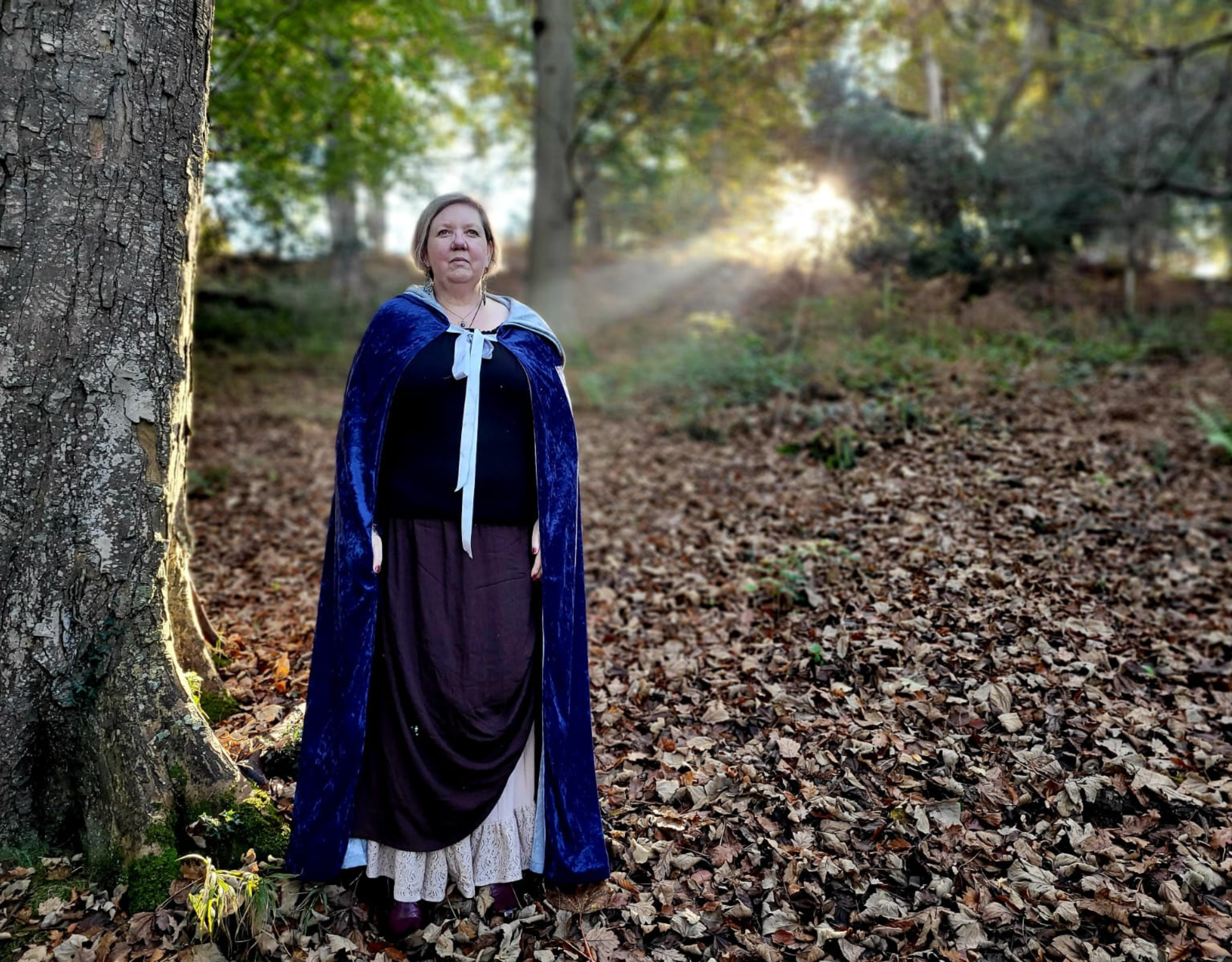
When You Stop Apologising for Taking Up Space
When You Stop Apologising for Taking Up Space
On the Sun at her fullest, the body that learned to shrink, and what becomes possible when you simply let yourself be there
In four days' time, the Sun reaches the peak of her year.
The Summer Solstice falls on the 21st of June, and with it comes the longest day. The fullest light. The moment when the sky is entirely, unapologetically herself. She does not wonder whether she is too bright. She does not dim herself out of consideration for those who might prefer the shade. She simply arrives in her fullness, and the world receives her.
There is something in that image worth sitting with.
Because many of us have spent years doing the opposite. Not arriving in fullness, but arriving in as little space as possible. Making ourselves quieter, smaller, softer, more manageable. Not because we are not radiant. But because somewhere along the way, we learned that our full brightness might be too much.
This piece is an invitation to put that learning down.
What playing small actually is
Playing small is not a character flaw. Let that land before anything else.
It is a response. A deeply intelligent, often protective response to environments that taught you, sometimes explicitly and sometimes simply through the atmosphere of the people around you, that less of you was safer. More welcome. More acceptable. For many of us, making ourselves smaller was not weakness. It was wisdom for the conditions we were in. It kept us emotionally safe, and sometimes in ways that mattered more than that.
The problem is not that you learned to do it. The problem is that the conditions changed, and the response did not.
Playing small can look like silencing yourself before anyone else can dismiss you. Minimising your achievements, your needs, your desires, before anyone else gets the chance. Saying yes when every part of you is saying no, then living with the quiet weight of having agreed to something that was never truly yours to carry.
It can look like imposter syndrome, standing in the doorway every time you try to enter a room you have every right to be in. Or boundaries worn so thin that your own energy leaks out and other people's floods in. Or the reflexive editing of everything you are about to say, checking first whether it is acceptable, whether you are allowed, whether honesty will cost you something.
Playing small also lives in the body. It is in the hunched shoulders and the lowered gaze. The voice that never quite fills a room. The way a woman can walk into a space and immediately contract, making herself easier to overlook. This is not vanity or shallow self-consciousness. It is the body doing exactly what it learned to do, responding to years of messages, spoken and unspoken, that said: your presence here requires justification.
The invitation of sacred reclamation is not to judge any of this. It is to name it. To see it clearly, with kindness, and to ask whether it still serves the woman you are becoming.
A story I want to tell you
For many years, I felt like I needed to apologise simply for entering a room. As though my presence there was somehow presumptuous. I did not feel like I fitted. Did not feel like I belonged. I felt awkward and incredibly self-conscious in my own body, in ways that were genuinely exhausting.
I had a mask that worked for a while. When I worked in education, I felt more comfortable, because I had a role to play. A clear function that gave me permission to be there. But underneath the professional confidence, everything still felt fragile. Take the role away and I was not sure who I was, or what right I had to be in the room at all.
Then I had my second breakdown, and everything collapsed. I lost the ability to take up even an inch of space. I could not leave the house on my own. If I needed to meet someone, they had to come to a specific place where I had some sense of safety. All my power had gone. All my confidence had gone. I stopped being me. I stopped dressing as I used to. I stopped doing the things I loved. I simply existed. And it was not a particularly kind existence.
What I know now, having walked the long way back from that place, is that playing small is not humility and it is not safety. It is giving your power away. It is the daily quiet transaction in which you exchange your authentic presence for the relief of not being too much.
I am not going to tell you that everything is resolved and radiant for me now, because that would not be honest. I am a work in progress. But I have learned, finally, that I am allowed to be in the room. I do not need to apologise for it. That shift, however slowly it has arrived, has changed things in ways I could not have anticipated.
The Sacred Sanctuary exists because I believe this work is richer, deeper, and more sustaining when it is not done alone. Every month, a circle of women gathers there to walk the path of sacred reclamation together, held by lunar wisdom, the turning of the seasons, and the particular medicine of being genuinely witnessed by other women who understand. If you are somewhere on this journey and you would love a place to do it in community, I would love to welcome you in. Membership is £30 a month. You can find out everything you need to know and join us here.
What taking up space actually looks like
Taking up space is not loudness. It is not performance. It is not demanding to be the most visible presence in every room.
It is presence. The simple, grounded, unhurried willingness to actually be where you are. To let yourself be seen without contracting. To speak without editing the life out of what you say. To walk into a space and not immediately begin calculating how small you can make yourself.
It is allowing yourself to have needs, to name them, and to treat them as genuinely worthy of attention. It is the ability to rest without apologising for it, to disagree without immediately softening yourself back into compliance, to want something without prefacing the wanting with a disclaimer about whether you have earned it.
In the body, it feels like releasing a breath you have been holding. A slight uncurling. Shoulders returning to where they actually belong. The quiet sense of occupying, rather than enduring, your own physical space.
And here is the part that tends to surprise women: when you take up the space that is genuinely yours, you are not taking it from anyone else. You are not crowding the room. You are completing it.
When you shrink yourself, something real is withheld. Not just from you, but from everyone who will never see the thing you dimmed. From the women watching who needed to see someone like them refuse to fold.
The sky right now
Since late April, Uranus has been in Gemini, the sign of voice, communication, and the exchange of ideas that moves the world. She is the great awakener, the planet that insists your authentic expression is not a disruption. It is your contribution. She is not remotely interested in the softened, edited, made-acceptable version of you.
But this week, the Sun herself has something to add.
She arrives at her absolute peak on the 21st of June. The longest day. The fullest light. And at that height, she offers something worth receiving: a sky-level demonstration of what full looks like. Of brightness at its maximum, with no apology for the reach of its own warmth.
You are not required to be smaller than you are. The sky is not, and you are made of the same light.
Where are you right now?
The scale below is not a test. It is a map.
Most women move between these spaces constantly. Some days you will feel deeply present and grounded in yourself. Other days, you may find yourself shrinking again, not because you have failed, but because this is how reclamation actually works. The practice is not arriving at ten and staying there. The practice is returning to yourself, again and again.
Sit with this gently. Notice where you are today, in this particular season of your life, without judgment and without pressure to be anywhere other than where you honestly are.
1. Invisible. You silence your needs before anyone else can dismiss them. You often feel like an observer in your own life rather than an active participant. You apologise for your feelings, your presence, your emotions, and your needs.
2. Shrinking. You are aware that you play small, but you are not yet sure how to stop. You minimise your dreams, your gifts, or your truth in order to feel safe, accepted, or manageable to others.
3. Awakening. Something inside you knows you were made for more. You are beginning to notice where you abandon yourself, stay silent, or hand your power away.
4. Questioning. You have started asking deeper questions. What do I actually want? Why am I afraid to be seen? Who taught me to make myself smaller? You are becoming conscious of old conditioning.
5. Reaching. You are beginning to take up space in small but meaningful ways. Perhaps you are speaking more honestly, setting boundaries, sharing your work, resting without guilt, or allowing yourself to be visible.
6. Reclaiming. You no longer want a life built entirely around pleasing others. You are actively reclaiming your voice, your desires, your body, your creativity, your spirituality, or your truth.
7. Embodying. You are learning that taking up space is not aggression. It is presence. You are becoming more comfortable being fully yourself, even when it makes others uncomfortable.
8. Rooted. You trust yourself more deeply now. You no longer need constant permission to honour your needs, your cycles, your emotions, or your path. You are beginning to live from self-trust rather than fear.
9. Radiant. You allow yourself to be seen. You share your voice, your wisdom, your creativity, and your presence without endlessly shrinking or second-guessing yourself. You understand that your existence is not something that needs justification.
10. Fully Reclaimed. You no longer apologise for the space you occupy. You understand that taking up space is not ego. It is embodiment. You move through life connected to your worth, your truth, and your sacred presence.
The scale above can help you see where you are. The Sacred Reclamation Compass offers somewhere to go next. It is a free guide that maps five territories of the journey home to yourself, each one a landscape you may recognise, each one a place where this work can begin, or deepen, or simply be witnessed. You do not need to move through it all at once. You simply follow what calls. If you would like your copy, you can download it here.
Questions to sit with
These prompts are not here to diagnose or assess you. They are here to help you listen. To notice where you feel safe, where you hold back, what shapes the way you move through your own life.
Where in my life do I still make myself smaller in order to feel safe, accepted, or loved?
What parts of myself have I learned to hide, soften, silence, or apologise for?
When do I feel most afraid of being fully seen?
Who benefits when I stay quiet, hidden, over-giving, or self-sacrificing?
What am I afraid might happen if I stopped shrinking?
Where have I confused taking up space with being too much?
What would change in my life if I trusted that my needs mattered?
What does my body feel like when I abandon myself in order to keep the peace?
In what areas of my life do I already feel grounded and fully myself?
If I fully believed I was worthy of being seen, heard, and valued, what would I do differently?
What would it look like to honour my voice without apology?
What does sacred reclamation mean to me in this season of my life?
The practice of returning
Sacred reclamation is not linear. It is not a switch you flick one morning, after which you walk into every room with full presence and unshakeable ease. Life does not work like that, and I would not trust anyone who told you it did.
What it is, is a practice of returning. Of noticing when you have contracted, without judgment, and choosing, when you are ready, to gently reclaim a little more of the space that was always yours.
One breath at a time. One room at a time. One honest word at a time.
That is the whole practice. And it is enough.
With love,
Beth