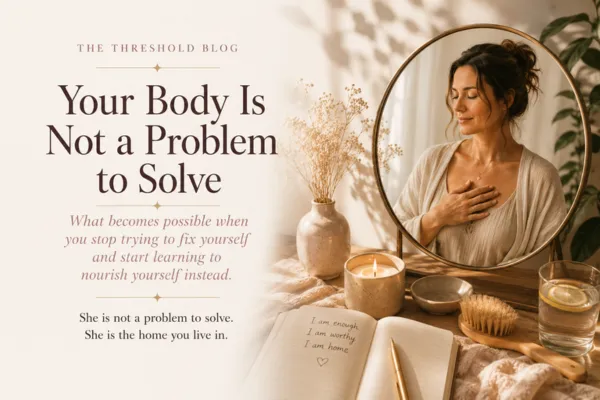
Your Body Is Not a Problem to Solve
Your Body Is Not a Problem to Solve
What becomes possible when you stop trying to fix yourself and start learning to nourish yourself instead
There is a particular kind of exhaustion that comes not from overwork, not from illness, not from life asking too much, but from years of treating yourself as a project that has never quite been completed.
Perhaps you recognise it. The quiet sense that you will begin properly when something changes. When the weight shifts, when the skin clears, when the energy returns, when you finally feel disciplined enough or motivated enough or different enough to deserve the care you keep deferring. The goalpost is always just ahead. The care is always conditional. The woman who gets to be truly, fully nourished is always a future version of you, not the one standing here now.
This blog is for every woman who has ever lived inside that bargain. And also for the woman who has never struggled with her body in obvious ways, but who has still somehow absorbed the cultural message that tending to yourself is something you justify rather than something you simply do. Because that message reaches all of us, in different forms and through different doors. And it does, quietly and over time, a great deal of damage.
The invitation here is not to overhaul anything. It is simply to ask a different question. Not: what is wrong with my body? But: what does my body need from me, and am I willing to give it?
The Story We Were Given About Bodies and Worthiness
We live inside a culture that has a great deal to say about bodies. About what they should look like. About what they reveal about us. About what we owe them, and more often, what we owe everyone else by keeping them contained, controlled, acceptable, and small.
Women in particular absorb these messages early. They come from everywhere, and they often arrive with the quiet authority of things we rarely think to question: advertising, family dinner tables, the language of health that sometimes says more about appearance than wellbeing, the subtle pressure to become a better version of ourselves, and the comparisons that begin young and never quite seem to disappear. What we absorb is not simply a set of ideas about our bodies. We absorb beliefs about our worth.
I know this territory from the inside. I have spent much of my life in a complicated relationship with my own body, moving through cycles of restriction and then searching for comfort in food, through diets that dressed punishment as discipline, through the particular unkindness of treating the very body that was carrying me through my life as the problem I needed to solve before my life could properly begin. The "when I lose weight I will" pattern, the deferred joy, the conditional permission: all of it.
What I came to understand, eventually and with some difficulty, is that none of it was self-care. It was self-management. And self-management, however well-intentioned, is not the same thing as love.
But this is not only a weight story. The same conditional logic shows up in the woman who restricts what she eats because control feels like the only steady ground she has. In the woman who runs until her body protests and then runs further, because stopping would mean she had failed. In the woman who looks objectively well in every mirror and still cannot find peace when she looks into one. In the woman who has done everything right, by every external measure, and still feels an undercurrent of disconnection from the body she inhabits.
The form varies. The root is the same: the body as something other than a home. Something to be managed, improved, endured, or at best, tolerated on the way to somewhere better.
What Nourishment Actually Means
Nourishment is not a diet. It is not a wellness plan, a programme or a set of rules about what you are and are not allowed to consume. These things may have their place, but they are not what we are talking about here.
Nourishment, in its fullest and truest sense, is what sustains a living thing. It is what allows something to grow, to function, to remain vital rather than merely surviving. And for a woman, nourishment operates on every level at once: the body she lives inside, the emotional landscape she carries, the quality of her rest and her relationships and her inner dialogue, the degree to which she feels genuinely held by her own life.
As I was writing this month's workbook for The Sacred Sanctuary, I found myself returning again and again to three threads that seem to sit at the heart of nourishment: receiving, tending, and belonging. Together, they reveal something I think many of us have quietly forgotten.
Receiving is the first and perhaps the most radical for many of us. Receiving means allowing yourself to be nourished, actively and without deflection. It means answering your own hunger, emotional and physical, before it reaches the point of depletion. It means accepting care when it is offered rather than insisting you are fine. So many women are extraordinary at giving, and quietly terrible at receiving. Nourishment begins the moment we are willing to let something in.
Tending is the second. The small, daily acts of care that are not luxuries but maintenance. The way you speak to yourself when you look in the mirror. The food you prepare and how you eat it. Whether you sleep when you are tired or push through and regret it. These are not indulgences. Tending is not indulgence. It is the maintenance of a living thing, and a living thing that is not tended does not thrive.
Belonging is the third, and the one that perhaps surprises us most when we find it listed alongside food and rest. But belonging is nourishment. The experience of being genuinely seen, of mattering to a community, of not having to carry everything alone, feeds something in us that no diet or programme can reach. We are not designed for isolation. We are sustained, in part, by the circles we belong to.
July inside the Sacred Sanctuary is woven through with exactly these three threads. Receiving, tending, and belonging are the heart of this month's work, explored across the lunar cycle with prompts, reflection, and the particular nourishment that comes from doing this work in the company of other women. If you are curious about what it would feel like to tend yourself with genuine consistency and in genuine community, you are warmly welcome to find out more here.
When the Punishment Stops
There may also be a quiet anger, and I think that belongs here too. An honest recognition that so many of us inherited ideas about our bodies that were never ours to carry. Ideas that taught us our worth could be measured, improved upon, or earned.
Anger is not the opposite of compassion. Sometimes it is the doorway into it. Sometimes it is the moment we decide we no longer wish to live by those old rules. The moment we stop asking our bodies to become something worthy of care and begin offering that care exactly where we are.
The crab in Cancer carries both her soft underbelly and her protective shell. She teaches us that tenderness and strength are not opposites. They belong together. The fierceness with which you choose to care for yourself is not a departure from self-care. It is part of it.
She Deserves Nourishment Now
Not when she has lost the weight. Not when she has cleared the skin or healed the relationship or sorted out the thing that feels most broken. Not when she has earned it through sufficient suffering or sufficient effort or sufficient self-improvement.
Now. As she is.
This is not a consolation prize. It is not a lowering of standards or a giving up or a resignation to something less than you wanted. It is a recognition of something that is simply true: the woman who is here today, in this body, in this life, is the one who needs to be nourished. Not the one who might arrive after the transformation. This one.
What that looks like in practice is not one thing. For one woman, it is eating a meal slowly and with genuine attention, without guilt about what is in it. For another, it is sleeping without the alarm to see what her body actually needs. For another, it is cancelling the commitment she said yes to from obligation rather than desire. For another, it is looking in the mirror and choosing, deliberately and against the habit of years, not to find fault with what she sees.
For all of them, it begins with the same moment: the decision to stop treating nourishment as something to be deserved and to start treating it as something to be given. Not as a reward. As a responsibility. The most sacred one you have.
Your body has been carrying you through every experience of your life. Every joy, every loss, every ordinary Tuesday, every moment of connection or courage or grief. She has done this without being asked. She has done it even when you were at war with her.
She is not a problem to solve. She is the home you live in. And she has been waiting, with remarkable patience, for you to come home.
If what you have read here has touched something in you that feels ready to be explored more deeply, Sacred Reclamation Coaching offers a one-to-one space for exactly that. The relationship between a woman and her own body, and her own worthiness, is some of the most important and most personal work there is. It deserves its own space, its own pace, and its own care.
You can explore Sacred Reclamation Coaching and begin with a free Sacred Conversation through the link below.
I would be honoured to walk alongside you.
With love, Beth