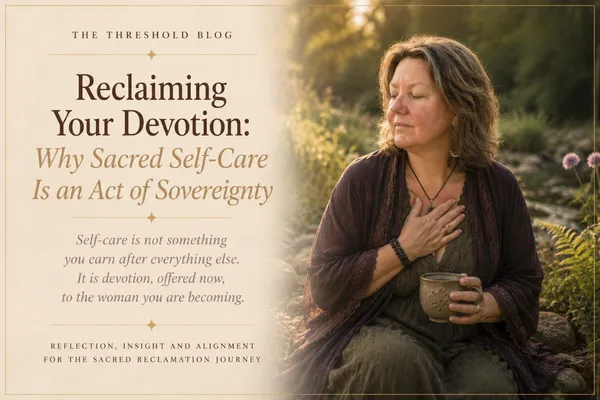
Reclaiming Your Devotion
Reclaiming Your Devotion:
Why Sacred Self-Care Is an Act of Sovereignty
Self-care is a phrase you hear everywhere, often beside images of candles, spa days and beautifully arranged morning routines. It is frequently offered as the answer when life has become too demanding, as though you should keep going until you are exhausted and then find something restorative enough to help you begin again. Even when you know that caring for yourself matters, you may postpone it until there is more time, more money or a sufficiently serious reason to stop.
Sacred self-care is something I have been deeply passionate about for many years. Long before I began naming Sacred Reclamation as a philosophy, it was woven through my work with women and through my understanding of what it means to come home to yourself. I believe sacred self-care is seriously misunderstood and profoundly undervalued. It is often reduced either to something indulgent and occasional, or to another collection of habits that a woman should perform correctly. Neither reflects the relationship I believe you are being invited to create with yourself.
I learned the importance of this relationship the hard way. I have experienced two significant breakdowns, both of which changed the course of my life. I would never romanticise the suffering within them, but looking back, I can recognise their initiatory quality. They took me into a darkness that stripped away my belief that I could continue overriding myself indefinitely. They showed me that the way I had been living was not sustainable and that caring for myself could not remain something I offered only after everything else had been tended. Those experiences became part of the path that eventually brought me here, and I can now feel gratitude for what they revealed without pretending that the journey through them was easy.
This is why I believe sacred self-care begins long before exhaustion or crisis. It begins with the small, intentional acts you can weave into the life you are already living. Not as an occasional response to depletion, but as a way of remaining present within your own life. Sacred self-care becomes a relationship, expressed through the choices by which you remember that your body, needs, inner life and spirit are worthy of your attention.
When care is always left until later
Self-care is often presented as something to add after everything else has been completed. Rest follows productivity. Time for yourself comes after work, family, responsibilities and the needs of the people you love. This can appear perfectly reasonable, especially when your life is filled with commitments you value and have consciously chosen. The difficulty is that life rarely reaches a point at which everything is finished and nobody needs anything from you. If your own care belongs only in the space left over, that space may never reliably appear.
Perhaps your life does not feel depleted or unmanageable. You may enjoy your work, love caring for your family and feel grateful for the responsibilities you carry. Sacred self-care is still relevant. It is not reserved for the moments when something has gone wrong. It asks whether you are present within the life you are creating, whether your needs have a place beside the needs of others and whether you are allowing care to support your wellbeing rather than waiting until you are struggling.
This is not about finding fault in the way you have lived or adding another expectation to your day. It is an invitation to notice the direction in which your attention and devotion naturally flow. You may give generously to your family, work, community, commitments and spiritual path. Sacred self-care asks whether some of that same presence, loyalty and tenderness is also allowed to flow towards you.
Sacred self-care is a relationship, not a reward
Sacred self-care begins with the understanding that care is not compensation for how much you have endured. It is one of the ways you remain connected to yourself while life is happening. It does not ask you to escape your life whenever it becomes difficult. It changes the way you inhabit that life by allowing your own presence, limits and needs to matter within it.
This does not diminish the value of having a massage or Reiki treatment, getting your nails done, going to the gym, attending a class or booking something special for yourself. Each can offer pleasure, rest and the important experience of allowing somebody else to care for you. They are not frivolous acts of ‘pampering’, and describing them that way can diminish their value. However, if self-care depends entirely upon spare money, physical energy, several free hours or access to a practitioner, it can become unavailable precisely when you most need to remain connected to yourself.
For me, sacred self-care begins with the small, intentional acts that can be woven into an ordinary day. It may be the way you prepare your morning drink, the breath you take before answering a difficult message or the decision to sit quietly for five minutes. It may be taking your medication, eating something nourishing, stepping outside to feel the air or lighting a candle as dusk gathers. The action may appear ordinary, but your presence within it changes its meaning.
These moments say that you are worth feeding before you become faint, worth listening to before your body begins to shout and worth speaking to with kindness when something goes wrong. Sacred self-care is found in whether you notice that you are uncomfortable, overwhelmed, disconnected or in need of support. It is present when you stop treating your body as an inconvenience and remember that she is the living place through which you experience your life.
Devotion is love given form
Devotion can sound like a weighty word. It may evoke religious obedience, solemn vows or spiritual discipline. Yet devotion, as I understand it, is much simpler and more intimate. Devotion is love given form. You already recognise it in preparing a meal for somebody you love, tending a garden, keeping a promise or making time for prayer. The action does not have to be dramatic. Its meaning comes from the relationship beneath it.
What might change if some of that devotion were consciously directed towards the relationship you have with yourself? This does not require you to feel loving, grateful or spiritually connected every day. Devotion is not a feeling you must continually maintain. It is the willingness to keep meeting yourself with presence and to allow that relationship to influence the choices you make.
Devotion is also different from obligation. Obligation says that something must be done, regardless of how disconnected you feel while doing it. Devotion remembers why the action matters. Lighting a candle because you believe a spiritual woman should light one every morning is not necessarily devotion. Lighting it to mark your return to yourself may be. Preparing food can be another task, or it can acknowledge that your body deserves to be fed. Rest can feel like an interruption, or it can honour the life within you.
Devotion is not proved by perfect consistency. There will be days when life interrupts, your capacity changes or a practice no longer fits. The return is part of the devotion. You can come back without apology, punishment or the belief that you must begin again from nothing. Sometimes the most loving act is noticing that you have drifted away and allowing yourself to come home.
Why devotion to yourself is not selfish
The fear of being selfish can arise as soon as you give your needs a more visible place. You may have absorbed the belief that a good woman should be endlessly accommodating or that love is demonstrated through self-sacrifice. You may feel comfortable giving care but uneasy receiving it, or support another woman in setting a boundary while feeling guilty when you establish one yourself.
Devotion to yourself does not mean placing yourself above everyone else or believing that only your needs matter. It means no longer treating yourself as the person who can always be overlooked. You can care for your family and include yourself within that care. You can be committed to meaningful work without offering it every part of you. You can love generously while recognising that your body, time, energy and inner life are not resources to which everyone else has unlimited access.
This is where sacred self-care becomes an expression of sovereignty. Sovereignty is not isolation, hardness or refusing to need anyone. It is the recognition that you belong to yourself. Your voice deserves to be heard within the decisions that shape your life. Your body is not merely something to push through or control. Your needs do not require another person’s approval before they become real. Sacred self-care says: I am not the only person who matters, but I am one of them. I am here for my own life.
This understanding lies at the heart of September’s journey inside The Sacred Sanctuary. I have created a new monthly workbook and journal, Reclaiming Your Devotion: Sacred Self-Care as a Way of Life, to help you explore this relationship over the course of the month. It includes in-depth teachings, thirty Invitations to Devotion, daily reflections, three journalling prompts and an affirmation for most days, an embodiment practice, rituals and dedicated pages for the Dark Moon, New Moon, Autumn Equinox and Full Moon.
The workbook is not a thirty-day challenge or another demand for perfect consistency. You can move through it each day, dip in and out or return whenever life allows. The Dark Moon Sister Circle on 8 September and Sacred Integration Circle on 24 September also offer opportunities to explore and embody the theme in community, with recordings available if you cannot join live.
Because this month's theme feels particularly close to my heart, I wanted to open the doors of The Sacred Sanctuary a little wider for September. I am offering ten women the opportunity to experience a complete month inside the Sanctuary for £15, rather than the usual £30. You will have full access to everything within the membership, including this month's workbook and journal, both members-only circles, the meditation library, previous workbooks and the Sanctuary community.
After your first month, membership continues at the usual £30 per month, with no obligation to remain if you decide the Sanctuary is not right for you.
If you would like to claim one of the ten September places, visit The Sacred Sanctuary and use the code SEPTEMBER50 when you join. Your first month will be reduced automatically to £15.
JOIN THE SACRED SANCTUARY FOR SEPTEMBER
September invitation: £15 for your first month, then £30 per month thereafter. Limited to ten new members.
Virgo and the sacredness of daily tending
Virgo is a meaningful guide for this month’s work. As an earth sign, she brings what you value out of the realm of ideas and into the physical world. An intention may begin in your mind and a prayer may rise through your spirit, but earth asks where it will be given form. How will this belief enter the life you are actually living? What action will help your body recognise that your care matters?
Virgo understands that a life is shaped through repeated actions. A path through a field is created because feet return to the same ground. Your relationship with yourself is formed in the same way. One glass of water, one conscious breath or one boundary may appear too small to change anything. Yet each time you respond to yourself with attention rather than dismissal, you deepen the understanding that you are worthy of care.
However, Virgo’s desire to tend, refine and support can become distorted into perfectionism and self-criticism. A devotional practice can quietly become another standard against which you judge yourself. The ritual must happen at the correct time, the journal must be completed every day and even self-care becomes something at which you can fail. This is not the Virgo wisdom I want to follow. Her deeper invitation is discernment. What genuinely supports you? What belongs within your present circumstances? What are you maintaining only because you believe you should?
Virgo is mutable earth, so her practices must be responsive enough to remain alive. What supports you when you feel well may not be available during pain, illness, grief or exhaustion. Adaptation does not weaken devotion. It allows you to care for the body, energy, time and resources you genuinely have, rather than creating a practice for an imaginary life in which nothing changes.
The body remembers what the mind tries to carry
Within the astrological health teachings I received, Virgo is associated with the abdomen, spleen and central nervous system, extending to the intestines, digestive enzymes and diaphragm. Virgo can run on nervous energy, and worry or prolonged tension may be experienced through the gut. This makes her relationship with daily care especially meaningful. Her invitation is not only to create useful practices, but to soften self-criticism, cultivate self-acceptance and develop ways of resting and releasing tension that genuinely support you.
Modern medicine also describes a two-way relationship between the brain and digestive system through the gut-brain axis. Emotional stress can disrupt digestive function, while the gut can also influence the brain and your responses to stress. This does not mean that every digestive condition is caused by stress, nor that illness reflects a failure to care for yourself properly. It reminds you that the different parts of your experience do not exist in isolation.
Virgo’s invitation is not to monitor every bodily response or turn health into another anxious project. It is to listen. To notice the clenched jaw, shallow breath, churning stomach or exhaustion you keep overriding. Sacred self-care cannot promise that listening will prevent illness or remove what hurts. It can help you stop abandoning yourself within the experience, seek appropriate support and meet your body with compassion rather than blame.
Planting one living seed of devotion
The New Moon in Virgo arrives on 11 September, offering a beautiful threshold for planting one small devotional seed. Not an elaborate routine or a promise to transform your entire life, but one honest intention that can be tended within the life you genuinely have. You might choose a morning prayer, a candle lit at dusk, a pause before opening your phone, a nourishing breakfast or one daily moment in which you ask what you need before the demands of the day become louder.
The question is not, ‘What should a devoted woman do every day?’ It is, ‘What small act would help me remain in relationship with myself?’ Let the answer be simple enough to live and responsive enough to change when your circumstances change. As the days begin to shorten, these ordinary rituals can become sources of warmth and inner sanctuary. There will be time to honour the seasonal threshold more fully as it arrives. For now, it is enough to recognise that what you practise in the light can help to hold you when the evenings begin to darken.
The Woman You Were Before
Devotion to yourself is not about returning to a life in which you had fewer responsibilities or pretending that your experiences have not changed you. It is about recognising the woman who still exists beneath everything you have carried and allowing her a fuller place within the life you are living now. Sometimes this begins privately, through one small daily act. Sometimes it is deepened by entering a circle in which you are given the space to listen, reflect and be witnessed.
Our first in-person Sacred Reclamation Gathering, The Woman You Were Before, takes place on Saturday 10 October. This gathering is an invitation to meet the woman beneath the roles, expectations and responsibilities you have gathered along the way, and to recognise what remains, what has been forgotten and what you may now be ready to reclaim. The early-bird invitation remains available until 12 September. If this calls to something within you, you can discover The Woman You Were Before and reserve your place.
You do not need to arrive with answers. You can enter the circle exactly as you are.