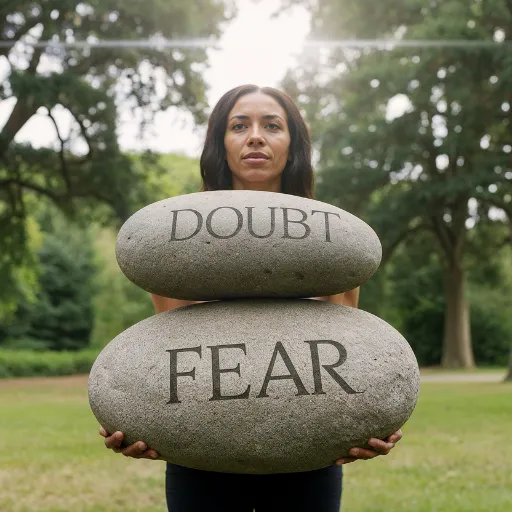
The voice beneath the voice
The Voice Beneath the Voice
On the stories we mistake for truth, the inner critic we learned to live inside, and what becomes possible when we finally choose to listen differently
There is a voice that most of us know intimately, even if we have never stopped to examine her.
She is the one who speaks before we have finished thinking. The one who edits before the words have reached our lips. The one who says not yet, not you, not quite in a tone so familiar we stopped noticing it was a voice at all. We began to believe it was simply the truth.
I know her well. I spent years living inside her version of reality, shaped by anxiety and depression in ways I didn’t fully understand at the time. She told me things about who I was, what I was capable of, what I was allowed to want, and I believed her. Not because I was naive, but because she was so constant, so convincing, so woven into the texture of my ordinary days that I had stopped being able to tell where she ended and I began.
This is what the critical inner voice does at her most powerful. She doesn’t announce herself as a critic. She presents herself as the truth.
Two Voices, Not One
Here is what I have come to understand, through my own long and sometimes difficult journey back to myself, and through the work I now hold with women: there are not one but two voices living inside most of us.
There is the voice that learned to speak in order to keep you safe. She absorbed the messages of your childhood, your family system, the culture you grew up inside, the relationships that shaped you before you had the language to question them. She learned what was acceptable, what was expected, what would keep the peace or earn the approval or prevent the rejection. She became very good at her job. So good, in fact, that many women never question whether the job was ever theirs to assign her in the first place.
And then there is the other voice. The quieter one. The one that has been waiting, patiently and without resentment, beneath all of that noise.
She is the voice that knows. Not loudly. Not with the brittle certainty of the inner critic, who is always asserting herself because she is fundamentally afraid. This voice speaks with a different quality entirely. Softer. Steadier. She is the voice that rises in your chest when something is genuinely true, and goes still when something is not. She is the voice that has been trying to tell you things, for years sometimes, that you have been talked out of hearing by the louder one above her.
She is the voice beneath the voice. And reclaiming her is one of the most important things a woman can do.
This is the heart of what we are exploring together inside the Sacred Sanctuary this June. Reclaiming Your Voice is our monthly theme, and the work of learning to hear and trust the voice beneath the voice runs through everything we are doing together this month. If you would like to be part of that conversation, membership is £30 a month and you can find everything you need to know here.
What the Critic Sounds Like
Imposter syndrome is one of the critic’s most common disguises, and one of the most crippling. I have sat with it myself, the absolute conviction that I would be found out, that what I knew wasn’t really knowledge, that my experience wasn’t really valid, that sooner or later the room would notice I didn’t belong there.
What I understand now, that I couldn’t see then, is that imposter syndrome is not a verdict. It is a symptom. It is what happens when the performed voice, the one who learned to shrink and qualify and hedge, has been running the show for so long that the authentic voice underneath feels foreign. Like an imposter. Like someone who doesn’t quite belong.
But she is not the imposter. She is the original. The performed voice is the one who was constructed. The real one has always been there.
We would never speak to a friend the way we speak to ourselves. Most of us know this. We have probably said it ourselves. And yet the knowledge doesn’t automatically change the pattern, because the pattern isn’t a choice we’re making consciously. It is a groove worn so deeply into the ground of our inner life that we walk it without noticing we’re walking it at all.
This is not a character flaw. It is a very human response to a very human experience. But it is worth examining. Because the way you speak to yourself shapes the life you believe you are allowed to live.
The Courage It Takes to Listen Differently
Here is the truth about the voice beneath the voice. Listening to her takes courage. Real, quiet, embodied courage.
Not because she is frightening. She isn’t. She is the most trustworthy presence inside you. But choosing to hear her means choosing to stop playing small. It means saying, however tentatively, I am ready to stop believing the version of myself the inner critic constructed. It means being willing to question stories that have felt like facts for a very long time.
That is not a small thing. For women who have lived with anxiety or depression, or who have carried imposter syndrome so long it has become the wallpaper of their inner life, that moment of choosing to listen differently can feel seismic. Not dramatic, necessarily. Often it is very quiet. But something genuinely shifts.
I remember the first time I caught myself in the middle of the old story and realised, clearly and simply, that it wasn’t true. Not because someone told me. Because I had finally gotten quiet enough to hear the other voice. The one that had been waiting. And what she said was so much kinder, so much more honest, so much more true than anything the critic had offered that the contrast was almost startling.
She wasn’t telling me I was perfect. She wasn’t offering a performance of positivity. She was simply telling me the truth. And the truth was that I was more capable, more worthy, more genuinely myself than the performed voice had ever allowed me to believe.
Learning to Speak From the Inside Out
Sacred Reclamation is, at its heart, the work of returning to yourself. And a significant part of that return is the reclamation of the inner voice. Not the performed one. The real one.
This means learning to notice when you are speaking from fear rather than from truth. Learning to hear the critic for what she is, a very old protection strategy, rather than an accurate reflection of who you are. Learning to ask, gently and without drama, is this actually true, or is this the story I was handed?
It means learning to be as honest, as patient, and as compassionate with yourself as you would instinctively be with a woman you love. Not because you have to earn that compassion. Because you already deserve it. You always have.
And it means being willing to let the quieter voice speak. To give her the room she has been waiting for. To trust that what she says, however unfamiliar it feels, is closer to the truth of who you actually are than anything the inner critic ever managed.
This is deeply individual work. The stories you have been living inside are not the same as anyone else’s, and the voice beneath yours is entirely, specifically, unrepeatable your own. Sacred Reclamation Coaching holds space for exactly that. One-to-one, unhurried, built entirely around you and the life you are genuinely here to live. If you feel the pull of what this is pointing toward, I would love to hear from you. You can discover more on my website and from there, book a free, no-obligation sacred conversation. Explore Sacred Reclamation Coaching here.
With love,
Beth